


My interest in Thomas Gent commenced when I was about ten years old, and discovered in my grandparents' attic a copy of his autobiography, published in 1832, sixty four years after his death. This was a cut and bowdlerised version, but I did go to York Minster about twenty years ago, and also acquired a microfilm of the original manuscript, so that I was able to make this available on the internet. I had hoped one day to write up my research on this distant relation.
Over the years I have acquired five other copies of this book, which I shall distribute amongst my family. I have multiple copies of several of his books that I have accumulated and shall similarly distribute. That original copy my parents had rebound for me at Peschiera, and this I have now given to my son.
I also purchased over the past twenty years other examples of Thomas Gent's work, mostly printed by him, but at the end of his life also printed by others. There is a list of works printed by Thomas Gent in 'A memoir of the York Press' by Robert Davies, originally published in 1868.
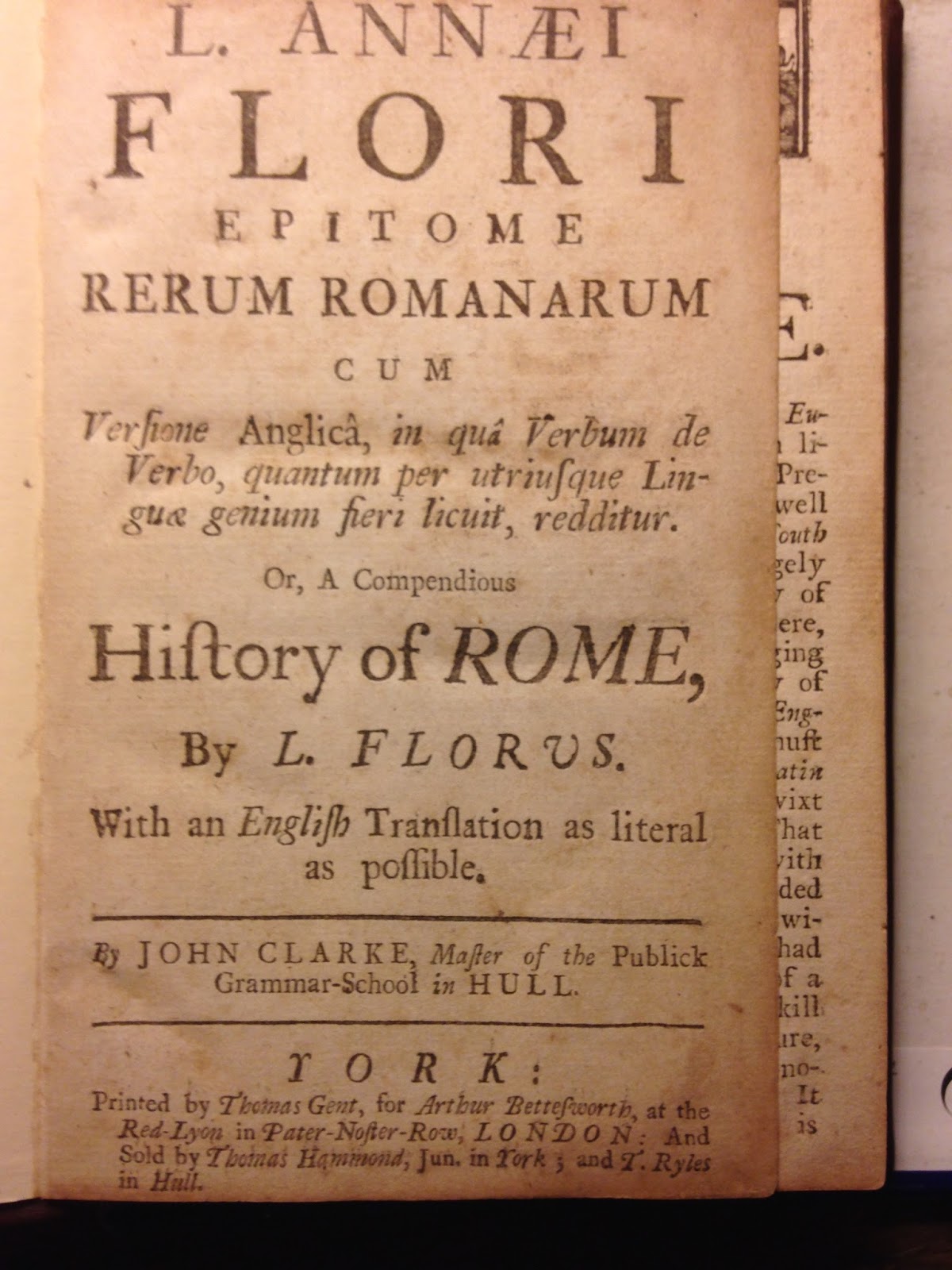
The 'History of Rome' by Lucius Annæus Florius is an early work produced by Gent in York, though undated.


I had two copies of Gent's 'History of York'. his own work, printed in 1730, both very nicely bound. I gave one copy to my nephew Joseph Gent, as he is studying law at the University of York.
My copy is quarter bound in brown Morocco. I purchased it in 2000 for £150. It has the frontispiece 'View of the City of York'.

I have three copies of Gent's 'History of Rippon' which he wrote and printed in 1733. The first copy was rebound in Victorian times, and gilded on all three edges, but the front cover is now detached and the back cover is missing.
The second copy is very imperfect. It lacks the front cover, but does have the original back cover, which has been crudely sewn back on. The title page and dedication are also missing. Also missing, and apparently always thus, are pages 19-20, 25-28, 43-44. pages 61-62 appear to have been torn out for the sake of the crude woodcut view of Cawood church.
My third and best copy is, however, also imperfect. Quarter bound in brown calf, the spine has been at some time recently expertly repaired. Internally, this copy lacks pages 31-38, and a woodcut view of St Mary's Abbey in York. The internal front cover carries the bookplate of Edward Fenwick Boyd (1810-1889). I have reproduced the missing pages from my other copies and tipped them in. Thomas Gent appears to have often been lackadaisical or cavalier in the collating of his books so that there are many variants.


I have four copies of Gent's 'History of Hull', which he wrote, and published in 1735. The first has its original calf binding, though the front cover is detached. The frontispiece East View of Hull has been mounted on linen. The second copy is also in brown calf, with blind tooling on the front and back covers. The marbled endpapers I'd guess to be early Victorian though. The third copy is nicely rebound with half binding in golden brown calf and matching marbled paper. The fourth copy is the finest, half bound in tan calf with linen cloth, fine dark blue marbled endpapers, and the armorial bookplate of William Henry Willatt, a Hull shipbuilder, 1868-1942. This copy has the additional portrait of Thomas Gent in his study. Typically of Thomas Gent, all four volumes vary in some particular.
I have two copies of the'History of Rome' in John Clarke's translation, dated 1728, the second edition printed by Thomas Gent, and the fourth edition of 1739 by an unnamed printer, but in a better quality of workmanship than that of Thomas Gent.
The 1728 copy is simply and attractively rebound in dark ochre cloth and a black Morocco spine by Delrue, presumably Paul Delrue of Ruthin in Denbighshire.


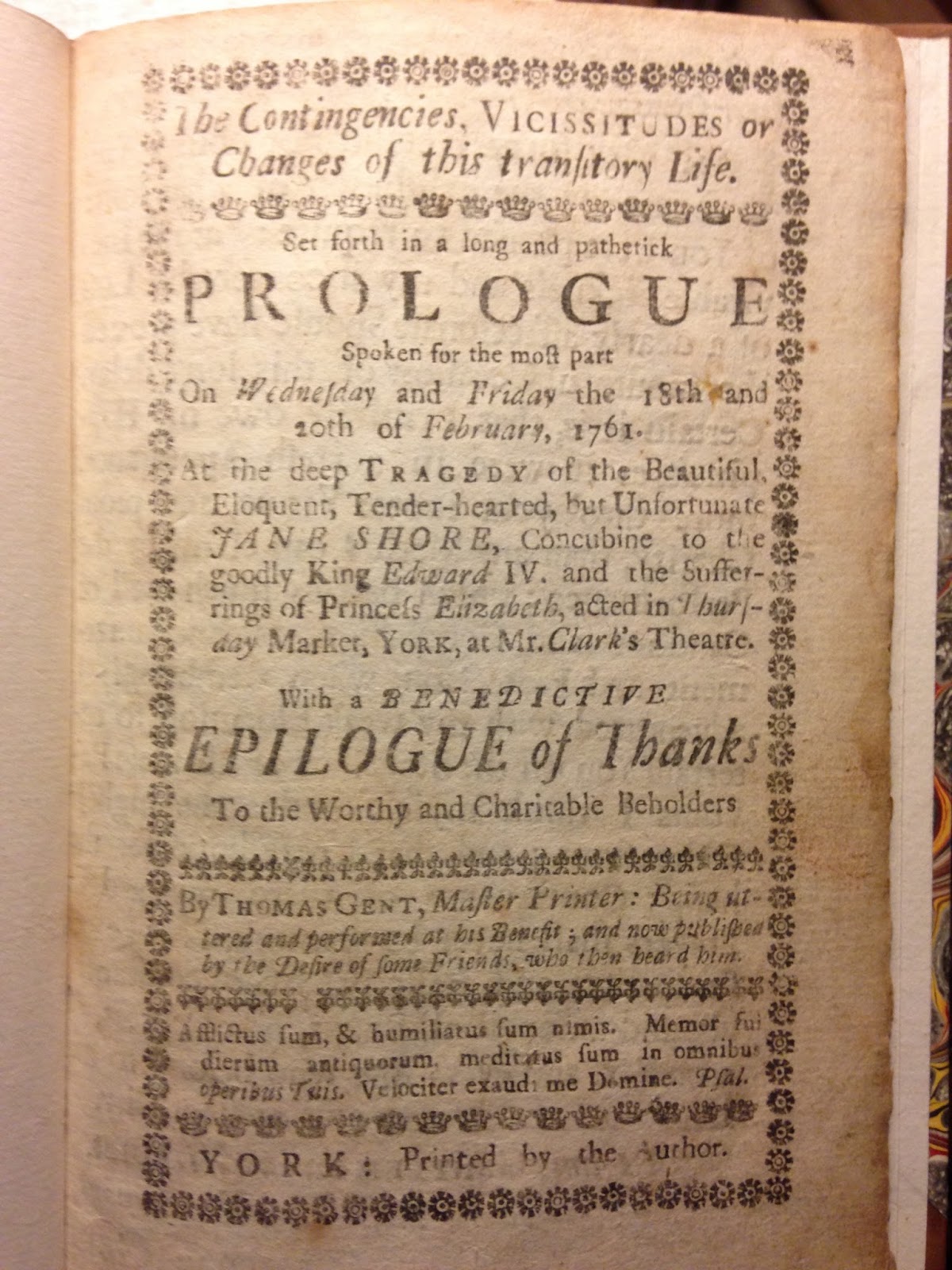
Thomas Gent's 'Prologue' was probably the first work by him that I purchased, and I had it rebound by David Squirrell. It is half bound in tan calf with a matching marbled paper. I believe that this is the last work produced by Thomas Gent from his press in 1761.


These two sermons, disbound from a larger volume, are the only copies I have managed to trace. Printed in 1725, they belong to the earliest period of Thomas Gent's sojourn at York. I am only aware of one earlier work published there by him, in 1724.


Thomas Gent's own work on St Winifred was printed in 1742 in five parts. My copy is in excellent condition, though the binding is a simple one of paper with a cloth spine.

This work, printed in 1736, has been disbound from a larger volume, and does have some additional pieces at the end.

Thomas Gent printed many works for John Clarke, but here again we have a second edition produced by another, and better, printer.


Thomas Gent's own work, a 'History of England', was printed by him in 1741. This copy is very complete, and has its original calf covers, though with the spine neatly replaced at a later date.

This was easily the most expensive book I ever bought, at $672, in 2004. This was considerably lower than the asking price however. This curious very late work by Thomas Gent is a hotch potch but fascinating and very rare. My copy has been carefully rebound preserving the original covers and spine. It lacks the large illustration of the great east window.
A useful explanation of traditional bindings is available at the abe.books website.
23rd January, 2017
Despite being very ill, I could not resist two purchases I made this month of books by Thomas Gent. The first was 'Historia Compendiosa Anglicana: or, a Compendious History of England...' [and] 'Historia Compendiosa Romana: or, a Comprehensive History of Rome'. I already had the first volume, but this was both volumes, at a very reasonable price, from Ken Spelman of York, and in matching bindings.


Earlier in the same week I purchased for a very low price the rare work 'Itinerarium Totius Sacrae Scripturae....or... An Abstract of the Lives and Travels of The Holy Patriarchs, Prophets, Judges, Kings, our Saviour Christ and his Apostles as they are related in the Old and New Testament with the meaning of every distinct book and chapter of the Bible from the beginning of Genesis to the end of the Revelation... by C.Brown, late of Norton, Gent. York, Thomas Gent...1746.'
This was an exciting addition to my collection, with its original binding.


This morning as I tidied my shelves I discovered another of Thomas Gent's books in my possession, his rare book of anthems, published in 1736.


I have a great deal of information about Thomas Gent in the site I have created, but which will unfortunately vanish in five years time. All this information can be found here.


